

Association of Oral Hygiene Status With Postoperative Complications in Patients With Duodenal Tumor: A Preliminary Retrospective Cohort Study
DOI:
https://doi.org/10.14740/cdoh1Keywords:
Duodenal tumor, Oral hygiene, Postoperative complications, Systemic inflammationAbstract
Background: Poor oral health may increase the risk of postoperative aspiration pneumonia in cancer patients. However, it remains unknown whether preoperative oral hygiene status affects the incidence of postoperative complications in patients with duodenal tumor. Therefore, we performed a preliminary retrospective cohort study to clarify the relationship between oral hygiene status and postoperative complications in patients with duodenal tumor.
Methods: We analyzed data from 36 patients with duodenal tumor who received surgery and perioperative oral health management at Hiroshima University Hospital between May 2013 and June 2024.
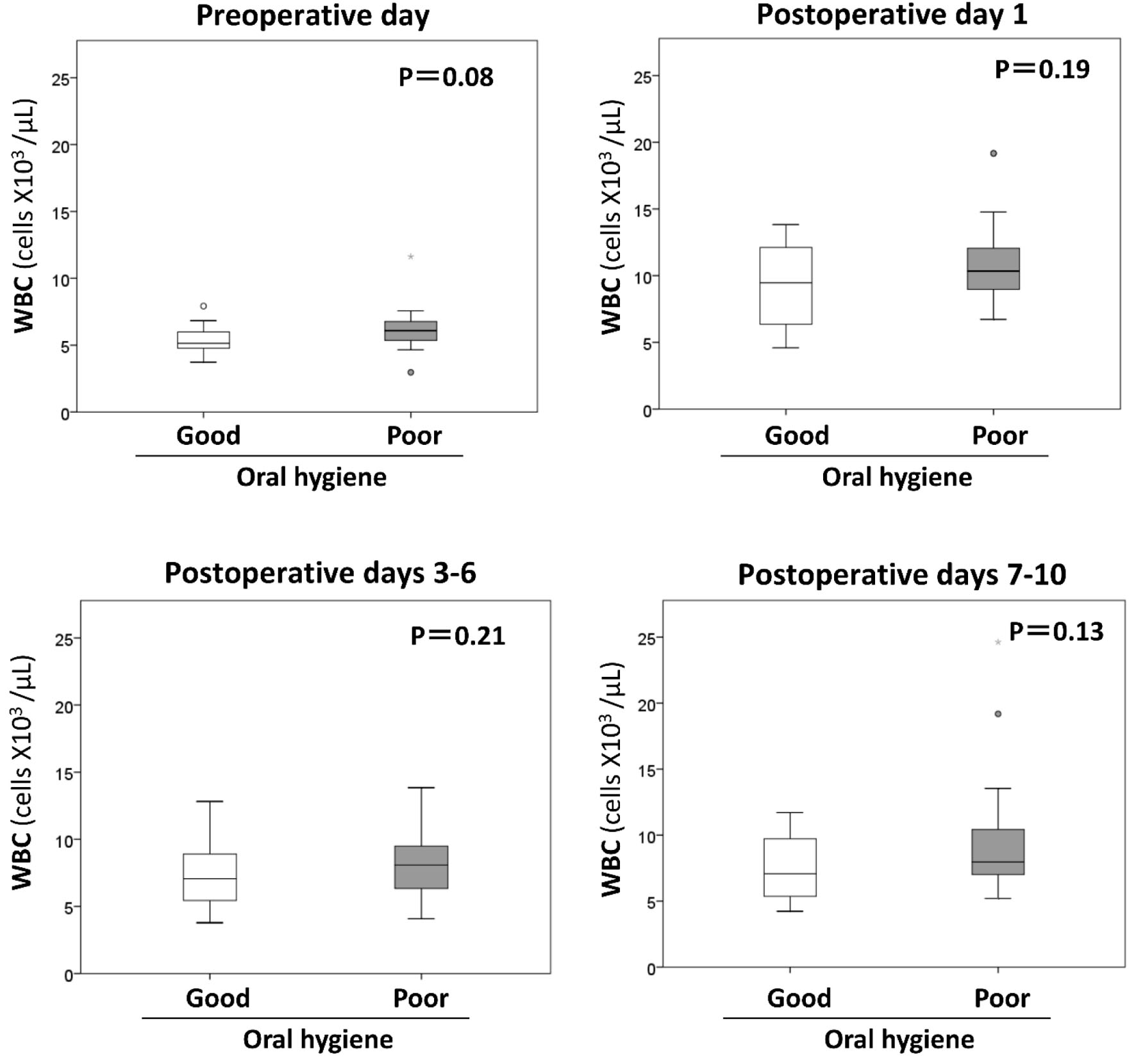
Results: We divided patients into good oral hygiene group (n = 18) and poor oral hygiene group (n = 18), according to dental plaque accumulation on the tooth surfaces. The poor oral hygiene group had a higher frequency of postoperative fever ≥ 38 °C (50%) than the good oral hygiene group (22.2%). However, no significant association was found between the groups (P = 0.16). Additionally, the poor oral hygiene group had a higher incidence of anastomotic leakage (5.6%) and pancreatic fistula (16.7%), in comparison with the good oral hygiene group (0% and 5.6%, respectively). However, this association did not reach statistical significance (P = 1.0 and P = 0.6, respectively). White blood cell counts were higher in the poor oral hygiene group than those in the good oral hygiene group on postoperative day 1, days 3–6, and days 7–10. There was a significant association between postoperative complications and patients’ age, surgical method, operation time, and blood loss during surgery (P = 0.04, P = 0.04, P = 0.04, and P = 0.01, respectively). Next, we conducted binomial logistic regression analysis using postoperative complications as the dependent variable and clinical variables (i.e., age group, surgical method, surgical approach, operation time, and blood loss during surgery) as the independent variables. However, we found no significant association between postoperative complications and such clinical variables (P = 0.94, P = 0.14, P = 0.53, P = 0.08, and P = 0.24, respectively).
Conclusions: Further research is needed to clarify the association between the oral health condition and postoperative complications in patients with duodenal tumor.
Published
Issue
Section
License
Copyright (c) 2026 The authors

This work is licensed under a Creative Commons Attribution-NonCommercial 4.0 International License.